
Source: Yangtze River Delta National Innovation Center
The 11th China (Shanghai) International Technology Fair, hosted by the Shanghai Municipal People's Government, grandly opened on June 11. Shanghai Mayor Gong Zheng and other officials visited the exhibition area showcasing the achievements of integrated science and technology innovation through regional collaboration in the Yangtze River Delta, organized by the Yangtze River Delta National Innovation Center, and listened to a report by Liu Qing, Director of the Center.
Before the opening ceremony of the China International Technology Fair, Shanghai Mayor Gong Zheng toured the exhibition venues with Chinese and international guests. During the tour, Mayor Gong and his delegation visited the exhibition area showcasing the achievements of integrated science and technology innovation through regional collaboration in the Yangtze River Delta, organized by the Yangtze River Delta National Innovation Center. Liu Qing, Director of the Center, briefed Mayor Gong on the Center's overall development, highlighting its coordinated technology planning in the aerospace sector, the nanometer-level precision ultra-precision air-bearing platform (UPSS) in the integrated circuit sector, and the desktop XAFS spectrometer, a desktop-scale atomic-resolution microscopic probe for high-end equipment applications. He also provided a detailed introduction to the Center's efforts to build a global innovation network and foster innovative cooperation with foreign-funded institutions.
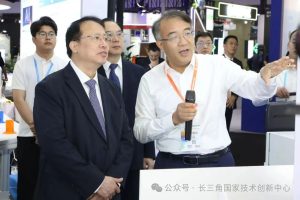
More than 40 exhibits from over 30 R&D platforms and high-tech companies within the organizational system of the Yangtze River Delta National Technology Innovation Center were showcased at the fair. Four themed exhibition zones were established, covering artificial intelligence, integrated circuits, biomedicine, and digital intelligent manufacturing, green energy, and engineering equipment, to present the innovation achievements and case studies of science and technology integration across the Yangtze River Delta. Numerous flagship exhibits attracted professionals from research institutions, universities, enterprises, and other sectors for exchanges and collaboration, thanks to their cutting-edge technological breakthroughs, innovative application scenarios, and significant market potential.
Shanghai Jushi Intelligent Technology Co., Ltd., supported by the Yangtze River Delta National Technology Innovation Center, showcased insightOS, a general-purpose embodied intelligence operating system designed for robotic applications. The system features core capabilities including real-time perception and scheduling, autonomous task planning, cross-platform compatibility, and intelligent collaborative control. It will be widely applied across industrial ecosystems such as intelligent manufacturing, intelligent education and practical training, smart agricultural operations, and smart homes and services, with the aim of advancing robots from being controllable to autonomous and from demonstrations to industrial applications.
Donghong Xinguang (Shanghai) High-Tech Co., Ltd., incubated and supported by the Yangtze River Delta National Technology Innovation Center, has developed miniaturized, low-cost, high-performance optical spectral sensing devices. These devices adopt an internationally pioneering architecture that combines optomechanical micro-scanning with precise negative-feedback control, offering high reliability, high precision, high detection sensitivity, and an excellent signal-to-noise ratio. Their applications include the detection of hazardous chemicals and gases, fire safety monitoring, and drug identification in the public safety sector; air and water quality monitoring in environmental protection; blood and body fluid analysis in healthcare and biomedicine; and consumer electronics such as smartphones and smartwatches.
Nantong Weizhen Pharmaceutical Technology Co., Ltd. showcased applications of microneedle delivery technology in skincare, beauty, drug delivery, and other fields. In skincare and beauty, microneedle patches deliver active ingredients, such as whitening and anti-wrinkle agents, directly into the deeper layers of the skin, significantly enhancing skincare efficacy. For chronic disease treatment, the company has developed long-acting sustained-release microneedle patches that enable continuous and stable drug release, reduce dosing frequency, and improve patient adherence to treatment. The company can customize and adjust microneedle materials, dimensions, and drug or active ingredient loading according to different application scenarios. Its current production capacity has reached 100,000 microneedle patches per day, and its GMP compliance has passed third-party audit and certification.
 English
 Chinese